
Guide to Rotating Proxies Unlimited Bandwidth and Tradeoffs
Learn how rotating proxies unlimited bandwidth work, their performance tradeoffs, cost and legal aspects, and when to choose them over managed API services.
Dalvo · July 20, 2026
Your scraper has been running all night. The target site is still reachable. Your code isn't crashing. But the bill keeps climbing because every retry, every image, every redirected request burns through metered proxy traffic. By morning, the team isn't asking whether the parser works. They're asking why a routine ingestion job suddenly costs more than expected.
That's where people start searching for rotating proxies unlimited bandwidth. The phrase sounds like an escape hatch: keep rotating IPs, stop counting gigabytes, and push as much traffic as your workflow needs. In practice, that promise comes with infrastructure limits, provider economics, and anti-bot side effects that most comparison pages skip.
Some teams do need that model. Others think they do, when the actual problem is unstable extraction, poor retry behavior, or a workflow that shouldn't rely on proxies in the first place.
Table of Contents
- Introduction to Rotating Proxies Unlimited Bandwidth
- Understanding Rotating Proxies and Unlimited Bandwidth
- Performance Scale and Anti-Bot Detection Tradeoffs
- Cost Legal and Ethical Considerations
- How to Choose Between Proxies and Managed Services
- Implementation Architecture and Proxy-Free Alternative
- Conclusion and Next Steps
Introduction to Rotating Proxies Unlimited Bandwidth
A common pattern looks like this. A team starts with a clean scraper and a metered residential proxy plan because it feels safe and flexible. The pilot goes well. Then volume rises. More pages get fetched, more media assets are pulled, and retries multiply when a site slows down. Nobody changed the business requirement, but bandwidth became the bottleneck.
That's when “unlimited” starts to look attractive.
The appeal is simple. You want IP rotation so your requests don't all come from one address, and you want billing that doesn't punish every extra gigabyte. If your workload includes crawling large catalogs, collecting public media, or feeding downstream analysis systems, per-GB accounting can become the operational headache rather than the parser itself.
Still, the market language confuses people. Some vendors use unlimited bandwidth to describe plans that aren't residential at all. Others advertise rotating pools but bury concurrency rules, fair-use controls, or speed ceilings in the plan details. The result is a lot of buyers comparing unlike products as if they were interchangeable.
Most confusion starts when buyers mix up three different things: rotating IPs, residential identity, and unmetered transfer. They don't usually come together in one clean package.
The useful question isn't “Which provider says unlimited?” It's “What infrastructure are they selling, what limits still apply, and what happens when anti-bot systems push back?”
That distinction matters even more for YouTube-related ingestion and download flows. In that world, raw bandwidth is only one part of the problem. Session behavior, bot checks, and extractor stability often matter more than the headline plan label.
Understanding Rotating Proxies and Unlimited Bandwidth
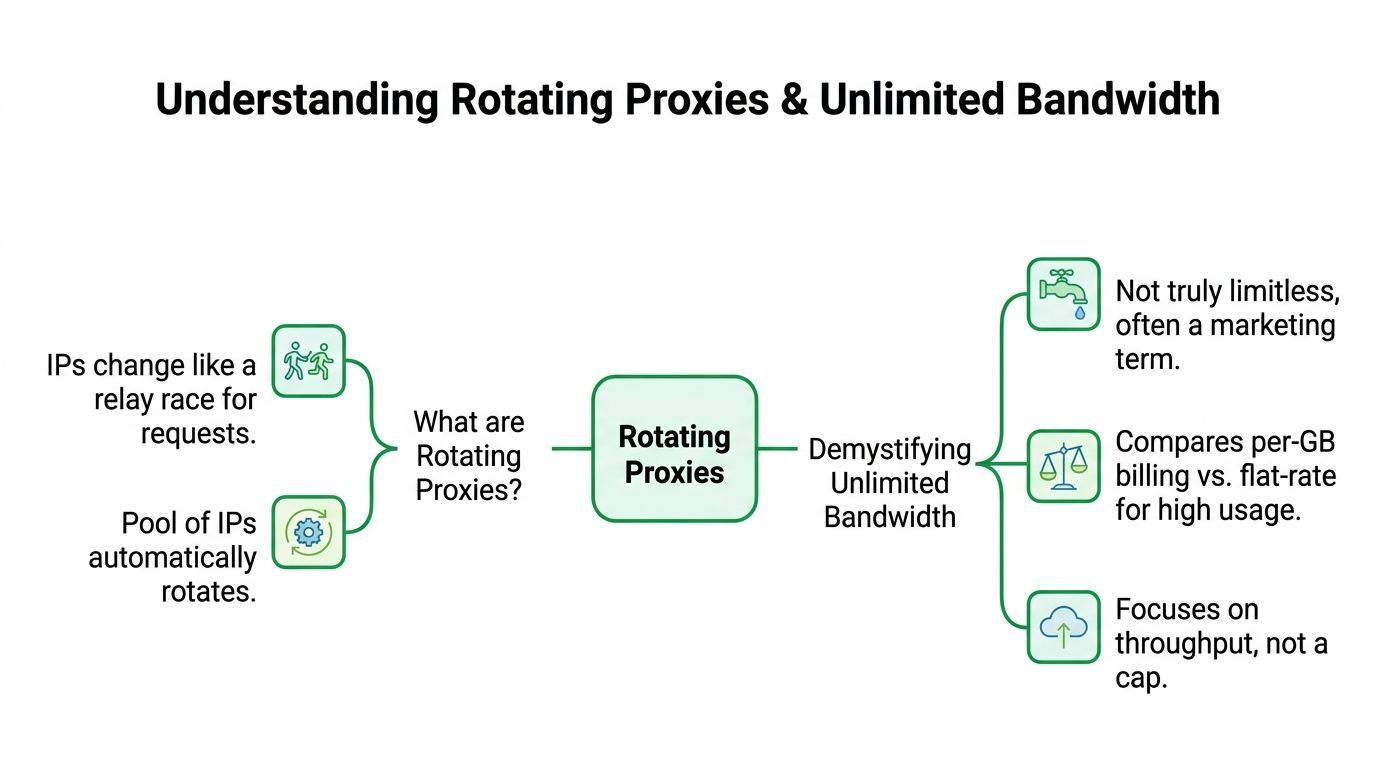
A rotating proxy changes the public IP address your request appears to come from. The request still leaves your app as usual, but somewhere between your code and the destination site, a proxy network chooses the exit point.
A bus terminal is a useful comparison. Your application is the passenger. The proxy provider runs the terminal. Each outbound request may leave through a different gate, even though the traveler started in the same place.
What rotating means in practice
Rotation usually happens in one of three ways, and the difference matters because each mode affects login state, cookies, and request continuity differently:
- Per-request rotation: every request can exit through a different IP. Good for broad distribution. Bad for flows that expect continuity.
- Session-based rotation: one IP stays attached to a short session, then changes later. Better for multi-step tasks.
- Pool-based rotation: the provider selects an IP from a larger pool based on its own routing rules, load, or availability.
That last point trips people up. Buying a rotating proxy does not mean you control the exact rotation pattern. In many services, you are renting access to a traffic system, not leasing a specific list of addresses.
Rotation spreads traffic across more than one IP, which can reduce the simplest form of rate-based blocking. It does not hide automation by itself. Sites still evaluate headers, cookies, browser fingerprints, timing patterns, and account behavior. If you have run into YouTube prompts that interrupt extraction flows, this breakdown of the “sign in to confirm you're not a bot” check shows why IP changes alone rarely solve the whole problem.
What unlimited bandwidth usually means
“Unlimited bandwidth” is a billing term first, and a technical promise second.
In practice, vendors often use it to mean you are not charged per gigabyte. You are usually paying for access to a fixed amount of network capacity, shared infrastructure rules, or both. The pipe is unmetered in accounting terms, but it still has shape. Speed caps, connection limits, fair-use controls, and routing policies still exist.
That is the hidden infrastructure piece many articles skip.
Providers can offer unmetered transfer more easily on datacenter networks because they control the servers, uplinks, and IP allocation more directly. Residential proxy networks are different. Those rely on consumer devices or ISP-assigned addresses, so traffic is usually treated as a scarce supply input and billed by usage. As a result, a plan that combines “rotating” with “unlimited bandwidth” is often built on datacenter infrastructure, even when the sales page makes the offer sound broader than it is.
A simple way to separate the models is to ask what the provider is charging for.
| Model | What you pay for | What usually constrains you |
|---|---|---|
| Metered residential | Data transferred | Total monthly usage, plus pool quality |
| Unmetered datacenter | Access speed or port capacity | Throughput ceilings, concurrency, and service rules |
That distinction matters for planning. If your workload is downloading large files, the billing model may look attractive. If your workload depends on looking like many ordinary households, unmetered transfer alone does not tell you much about whether the proxy layer fits the job.
The short rule is practical. Treat “rotating proxies with unlimited bandwidth” as a datacenter-oriented offer until the vendor clearly documents otherwise. That one check prevents a lot of category mistakes.
Performance Scale and Anti-Bot Detection Tradeoffs
A team can buy a proxy plan with plenty of transfer capacity, fire up a large job, and still watch the success rate collapse within minutes. The reason is simple. Anti-bot systems judge behavior, not just how much data your line can carry.
That distinction matters more at scale.
A wide pipe helps with file transfer and parallel fetches, but defended sites usually react to request patterns first. If hundreds of requests arrive with the same timing quirks, weak header consistency, or retry storms, the target starts scoring the traffic as automation. At that point, the bottleneck is no longer network capacity. It is detection tolerance.
Proxy analysts at Proxyway's rotating proxy overview note a common pattern in open rotating pools: latency rises and success rates fall compared with more controlled access models. The business reason is easy to miss. Services sold around unrestricted usage tend to attract heavier abuse, which puts more pressure on the shared IP pool. In practice, that can mean you are renting a faster road that is already watched more closely.
A workshop analogy helps here. Raw bandwidth is the width of the highway. Anti-bot resilience is whether your car blends into traffic. An eight-lane road does not help if every vehicle in your convoy enters at the same second, uses the same paint color, and takes the same exit.
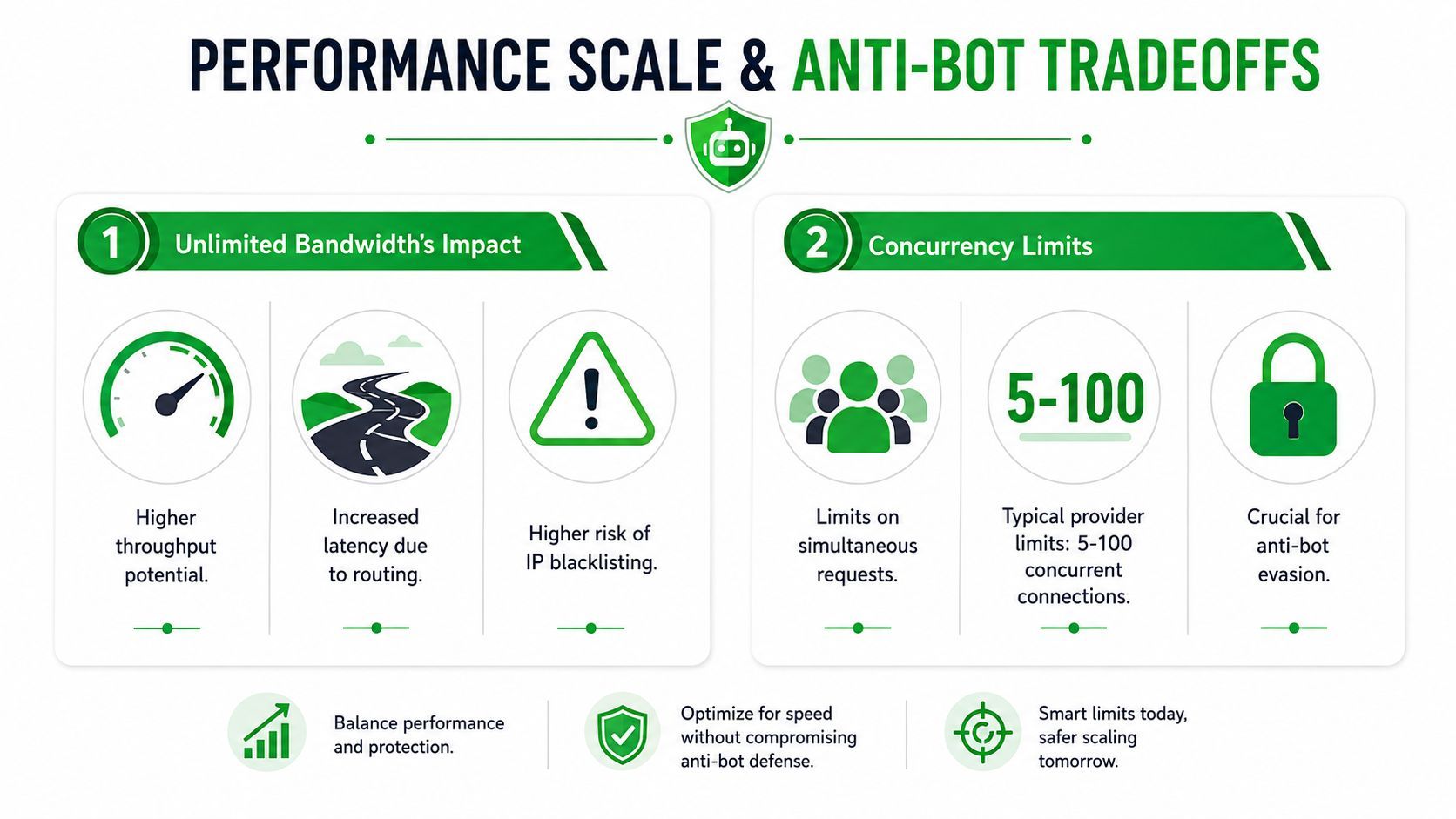
The operators who get stable results usually tune the traffic shape before they ask for more scale:
- Parallelism by domain: spread concurrency carefully so requests do not arrive in suspicious bursts from many rotating exits at once.
- Header coherence: keep user agent, language, timezone, and fetch behavior aligned so each session looks internally consistent.
- Retry discipline: back off after failures instead of retrying instantly and teaching the target to flag the pattern.
- Session strategy: decide where short rotations help and where a stable session is less suspicious than constant IP churn.
This is also where the hidden infrastructure and business trade-offs behind "unlimited bandwidth" claims show up in real operation. A provider can offer large transfer capacity, but that says nothing about IP reputation, pool cleanliness, or how many other customers are pushing noisy traffic through the same network. Those are separate engineering problems. Marketing pages often compress them into one promise.
YouTube is a good example because its defenses often surface above the transport layer. Instead of a neat rate-limit message, you may hit verification prompts, broken playback fetches, or account-related friction. The practical guide on YouTube's sign-in to confirm you're not a bot error shows how these failures appear in real request flows.
That point leads to a useful decision rule. If your workload depends on looking believable to a platform with strong detection, buying more proxy bandwidth may solve the wrong problem. In some YouTube download workflows, a managed or proxy-free architecture works better because it removes the shared-IP reputation problem instead of trying to outrun it with more rotation.
If the target scores behavior, optimize for believable sessions first and throughput second.
For teams that want a visual explanation of how these failures surface in YouTube-related flows, this video gives a useful overview:
Cost Legal and Ethical Considerations
A flat monthly proxy plan can look simple on a pricing page. Under the hood, it usually reflects a very specific network design and a very specific business model.
Here is the practical reading of an "unlimited bandwidth" claim. Datacenter proxy sellers can often offer unmetered transfer because they run on server infrastructure they control and can capacity-plan like a hosting company. Residential and mobile proxy networks work more like a supply chain. Every IP comes from a consumer or carrier environment with higher acquisition, routing, and replacement costs. That is why, as noted earlier, "unlimited" is far more common in datacenter products than in true rotating residential pools.
A good analogy is trucking. Moving pallets between two company-owned warehouses is cheaper and easier to price than paying thousands of independent drivers by route, region, and availability. Datacenter traffic resembles the warehouse model. Residential rotation resembles the independent-driver model.
That difference matters because teams often compare plans as if bandwidth, IP quality, and legal exposure were bundled into one number. They are not. A cheaper unmetered plan may save money on transfer while creating more work in retries, complaint handling, and blocked sessions. A metered plan may cost more per GB but reduce friction if the target cares about IP reputation or geography.
Here is the practical split:
- Datacenter plans: usually fit high-volume fetching where raw transfer matters more than identity quality.
- Residential or mobile plans: usually fit cases where the source of the IP affects trust, but pricing commonly follows usage.
- Static residential offers: may include unlimited transfer, but they are a different product from a rotating residential pool.
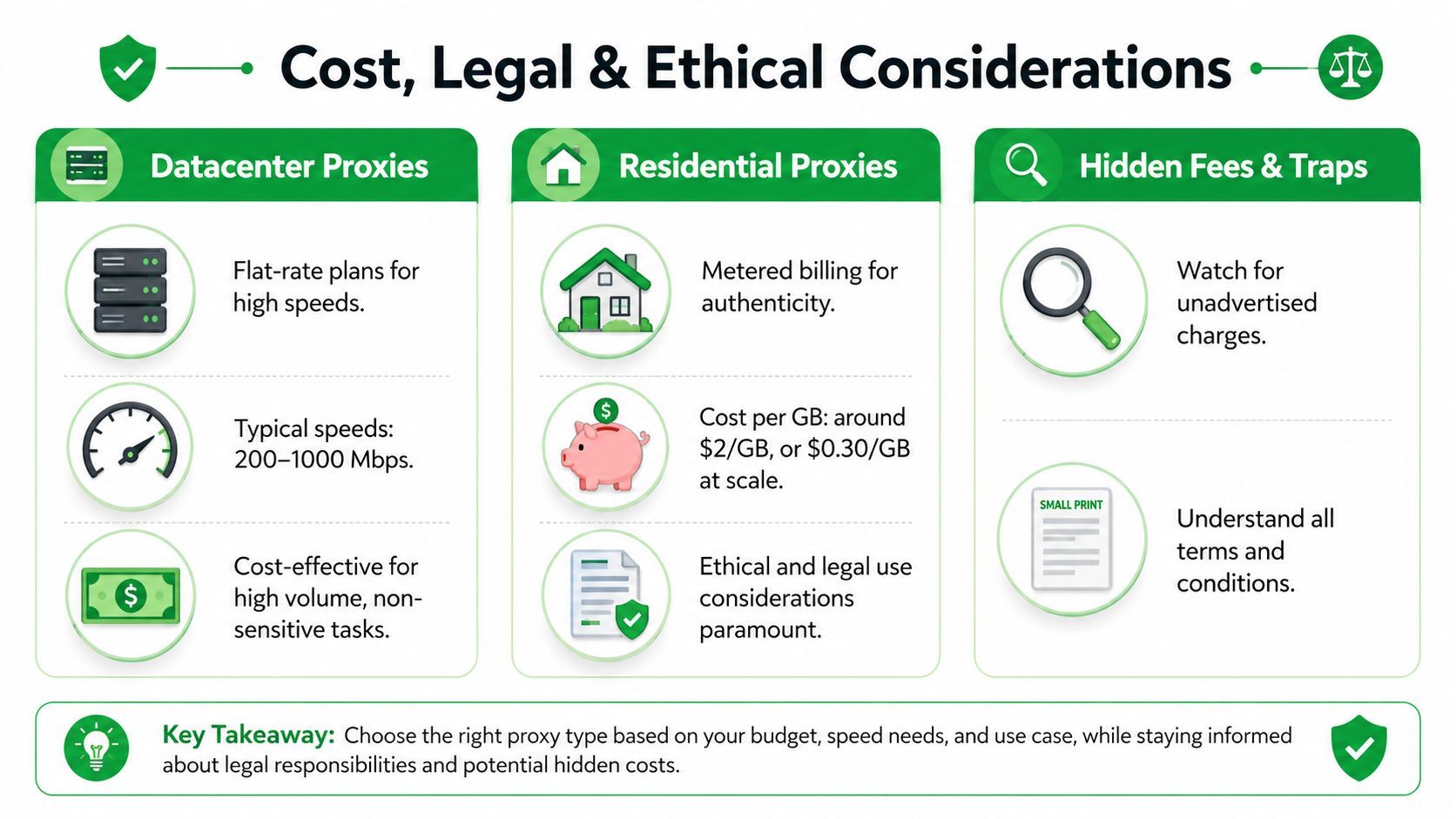
The fine print decides whether the plan works in production.
| Check | Why it matters |
|---|---|
| Fair-use language | "Unlimited" may still trigger throttling or account review during heavy sustained use |
| Concurrency rules | High transfer capacity means little if session counts are capped |
| IP type wording | "Residential" can mean static ISP access rather than rotating consumer IPs |
| Acceptable use terms | Some targets, automation patterns, or media workflows may violate provider rules |
Legal review belongs in the design phase, not after launch. If a team is collecting public pages, downloading media, or touching account-gated content, counsel should review target terms, copyright limits, access controls, and local rules before engineering scales the job. This is especially important for YouTube-related pipelines, where a proxy choice can turn a simple integration into a policy problem. A small YouTube download API integration example shows why many teams choose a narrower, purpose-built workflow instead of building a broad proxy stack around media retrieval.
Ethics are simpler than the marketing language makes them sound. Collect the minimum data you need. Respect rate signals. Stop when a site clearly does not want automated access. "Publicly reachable" only describes network exposure. It does not answer whether large-scale extraction is appropriate, contractually allowed, or wise for your organization.
The cheapest plan on the invoice can still be the most expensive plan to operate.
How to Choose Between Proxies and Managed Services
Some teams need raw proxy infrastructure because they scrape many different targets with custom logic. Others are trying to solve one narrow workflow, such as ingesting YouTube media, and end up building a fragile proxy stack around a problem that isn't really about proxies.
One market reality helps frame the decision. A lot of content around rotating proxies unlimited bandwidth wrongly treats unlimited plans as if they were rotating residential pools, even though genuine unmetered residential offerings are rare and often restricted by fair-use controls, as summarized in this review of unlimited residential proxy claims.
A practical decision matrix
| Criteria | Rotating Proxies | Managed Service |
|---|---|---|
| Control | High control over request behavior and routing | Lower infrastructure control, higher abstraction |
| Maintenance | You own retries, rotation policy, headers, failures | Provider handles most transport complexity |
| Cost predictability | Varies with plan type, retries, and operational mistakes | Usually easier to forecast per job or per API unit |
| Best fit | Multi-target scraping and custom collection logic | Single-purpose workflows with known inputs |
| Legal review load | You often need to assess target behavior directly | Still required, but technical handling is more centralized |
| Time to production | Slower if you need tuning and anti-bot hardening | Faster when the workflow matches the API's scope |
When each path fits best
Choose rotating proxies when you need flexibility across many sites, custom parsers, and your team already knows how to tune concurrency, session reuse, and backoff logic. In that case, proxy infrastructure is part of the product.
Choose a managed route when the job is narrower and repeated. For example, if the requirement is “take a YouTube URL and reliably get media or metadata,” building your own proxy rotation can turn into a side project with constant maintenance. This walkthrough of an API integration example for YouTube retrieval workflows shows the shape of that alternative.
A simple rule helps:
- Broad target coverage needed: proxies make sense.
- Single-source media ingestion needed: a managed service is often cleaner.
- Team lacks anti-bot operations experience: avoid DIY unless you have time to absorb failures.
That last point matters more than is often acknowledged. Infrastructure ownership sounds attractive until someone has to babysit it.
Implementation Architecture and Proxy-Free Alternative
If you do build around proxies, keep the architecture boring. Boring systems survive traffic spikes better than clever ones.
A workable proxy rotation blueprint
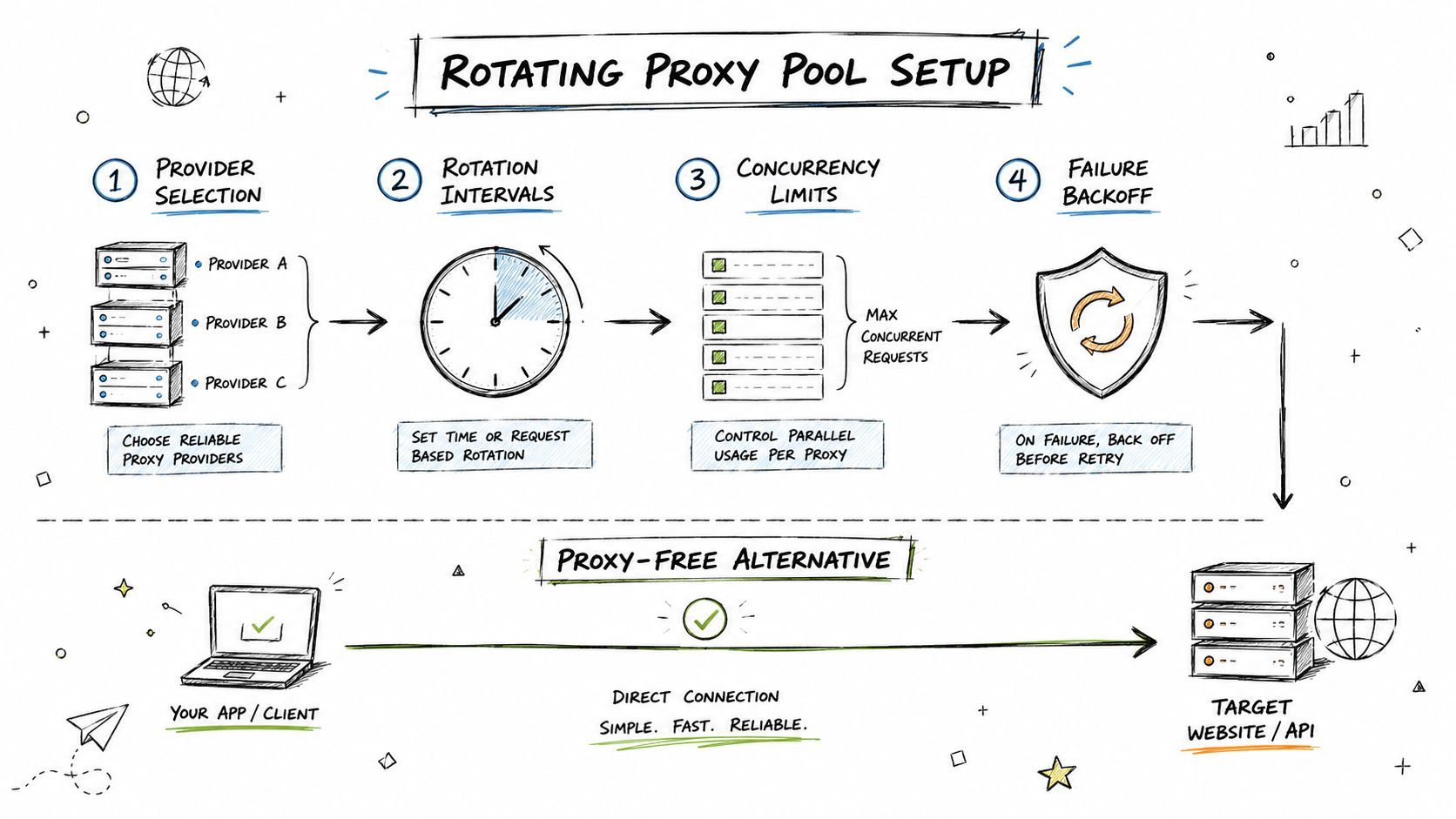
Start with a small control loop:
-
Choose the right network type
Use datacenter rotation for high-volume, lower-sensitivity targets. Use residential or mobile only when the target's defenses justify the extra cost and complexity. -
Define rotation rules before launch
Decide whether you need per-request rotation or short sticky sessions. Login flows, paginated navigation, and asset fetching often behave better with temporary session continuity. -
Set concurrency as a first-class limit
Don't let workers scale freely. Keep per-domain request counts under explicit control. If success rate drops, reduce parallelism before changing anything else. -
Add backoff and error buckets
Separate network timeouts, target throttling, bot checks, and content-level failures. A retry that helps after a timeout may hurt after a verification challenge. -
Log the request shape, not just the response code
Track timing, headers, session duration, and whether a request came from a fresh or reused exit. That's how you spot patterns behind sudden failure clusters.
Operator note: A proxy pool usually fails from poor orchestration before it fails from lack of raw capacity.
A minimal architecture often includes a job queue, a fetch worker, a session manager, a rate controller, and a result store. Keep the rate controller independent. When anti-bot pressure rises, you want one place to slow the whole system down.
A simpler route for YouTube workflows
For YouTube downloads or media ingestion, many teams can skip proxies entirely and call a service that handles extraction, bot detection, retries, and direct delivery upstream. The flow is usually asynchronous: submit a URL and output format, receive metadata early, poll for job completion, then consume a direct download link when the file is ready.
The implementation shape is straightforward:
import requests

API_KEY = "YOUR_API_KEY"

headers = {
    "Authorization": f"Bearer {API_KEY}"
}

payload = {
    "url": "https://www.youtube.com/watch?v=example",
    "format": "mp4"
}

job = requests.post("https://api.youtube-download-api.org/v1/jobs", json=payload, headers=headers)
print(job.json())
Then poll until the job finishes:
import time
import requests

job_id = "returned_job_id"

while True:
    r = requests.get(f"https://api.youtube-download-api.org/v1/jobs/{job_id}", headers=headers)
    data = r.json()
    print(data["status"])
    if data["status"] in ("completed", "failed"):
        print(data)
        break
    time.sleep(2)
The operational upside is that your application logic stays focused on job state and content handling rather than proxy health. If you've been fighting extraction errors, this discussion of yt-dlp 403 forbidden failures gives a good sense of the maintenance burden you avoid.
That doesn't make proxies obsolete. It just means they aren't always the right layer to own.
Conclusion and Next Steps
The phrase rotating proxies unlimited bandwidth sounds simple, but the underlying tradeoff sits below the marketing. “Unlimited” usually points to datacenter economics, not a magical rotating residential pool. High throughput can help, but it won't erase latency penalties, concurrency limits, or anti-bot scrutiny. And if the workflow is narrow, building a proxy stack can create more moving parts than it removes.
Audit your workload before you buy anything. Check the target type, request pattern, failure mode, compliance risk, and how much infrastructure your team wants to run. Then test with a pilot that measures success quality, not just traffic volume.
If your use case is broad scraping, a tuned proxy architecture may be worth the effort. If your use case is YouTube ingestion, a proxy-free path may get you to reliable production faster.
If you need a production-ready way to retrieve YouTube media without managing proxies, cookies, or extractor breakage, take a look at YouTube Download API. It provides an async REST workflow for submitting a YouTube URL, getting metadata quickly, and receiving direct CDN download links for video or audio when processing completes.